The first time I built software that other people actually used, I didn’t have a CS degree, and hadn’t written a meaningful line of code since I was learning HTML by hand in Notepad back in 2001.
I’d just told an AI what I wanted. Eight minutes later, I had a working app.
If you’ve been hearing the term vibe coding and wondering whether it’s real — or whether it’s another overhyped AI buzzword — this guide is the one I wish I’d had a year ago. It’s the practical, founder-tested playbook. No theory. Just what to type, what to expect, and how to avoid the five traps that waste the most time.
By the end, you’ll have a clear first project, a workflow you can repeat, and a realistic sense of what vibe coding can (and can’t) do for your business.
What vibe coding actually means in 2026
Vibe coding is the practice of building software by describing what you want in plain English and letting AI write, test, and iterate the code for you. The term was coined by AI researcher Andrej Karpathy in early 2025, and it’s gone from a clever phrase to a real job description.
In 2026, vibe coding isn’t a novelty. It’s a layer of the stack. Thousands of bootstrapped founders are shipping landing pages, internal tools, membership sites, and even customer-facing apps this way — without hiring developers.
The shift is simple: you stop writing code and start directing it. You describe the outcome, react to what’s built, and steer the AI through changes.
That’s it. The rest of this guide is how to do that well.
Their are many tools you need to start
But, I only use ONE…and it’s called OverSkill!
Why?
Because you don’t need all the sometimes confusing tools. Here’s what include in OverSkill and so much more:
- All the latest AI coding tool
- Built in Prompt builder
- Voice to text
- Builds your App/Site
- Deploys your App/Site
You have it all in one place, one tool, 100% of what you need to deliver a finished product!
How to start: your first vibe coding project in 90 minutes
The biggest mistake new vibe coders make is starting too big. Your first project should be small enough that you can ship it in one sitting and embarrassing enough that you don’t mind showing it to nobody.
Here’s the project I’d start with today:
Build a one-page landing site for a free thing you can give away. A lead magnet, a discount code, a checklist — anything that takes a name and an email.
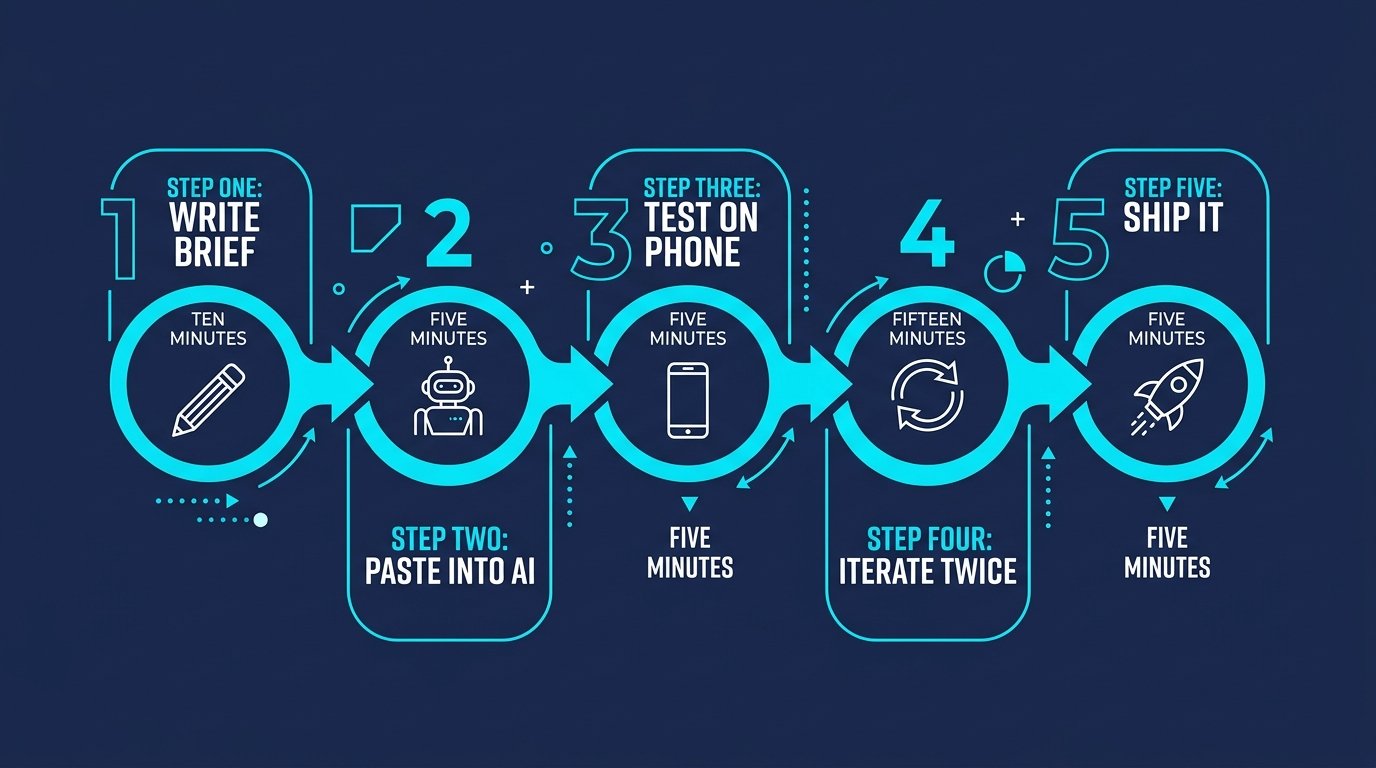
Step 1: Write a one-paragraph description (10 minutes)
Before you touch the AI, write this out by hand:
“A single-page website with a clean modern design. Top section: a headline that promises [outcome], a sub-headline explaining who it’s for, and an email signup form with a button that says [action]. Below the form: three short bullets explaining what they’ll get. Footer: a simple copyright.”
That’s your whole brief. It doesn’t need to be elegant. It needs to be specific.
Step 2: Paste the brief into OverSkill AI tool (5 minutes)
Hit go. Most tools will scaffold the page in 60-90 seconds. You now have something to react to.
Step 3: Test it on your phone (5 minutes)
This is where 90% of vibe coders skip and regret it. Open the preview on your phone. Try the button. Read the bullets out loud. Anything that feels awkward, copy and paste into the AI: “The button label feels salesy. Make it simpler and more direct.”
Step 4: Iterate twice (15 minutes)
You’ll need about two round trips to get something you’re willing to show a stranger. Keep them tight. Each round should make one focused change.
Step 5: Ship it (5 minutes)
Publish it. Email it to ten people. Move on.
You now have a vibe-coded artifact in the world. That’s the gateway. Every bigger thing you’ll ever build follows the same five steps at larger scale.
A real example: how I built My Family Circle with vibe coding
Theory is cheap. Here’s what actually shipped.
A few months ago I wanted a small app my extended family could use to share photos and quick updates — nothing commercial, just something private. The old me would have hired a developer or bought an off-the-shelf app and tried to bend it to my needs.
Instead, I sat down and described what I wanted:
“A simple web app where my family can log in with a password we all know, see a feed of recent updates with photos, and add their own update with a photo upload and a short caption. The vibe should be warm — blues and soft pinks — and the home screen should show the most recent update first.”
I watched the AI build the structure. I tested the upload flow. I asked for two design changes (the logo felt cold, the feed didn’t sort by date). About forty minutes later, I had a working app my family actually uses.
No developer. No $30K budget. No waiting six weeks for sprints.
That’s not a flex. It’s the new normal. The only reason I could do it is the same reason you can: I knew exactly what I wanted before I asked for it.
The mindset shift most CEO/Entrepreneur’s miss
Here’s the part nobody talks about. Vibe coding doesn’t reward technical skill — it rewards clarity of intent.
The founders who thrive with it are the ones who can answer questions like:
- Who is this for, exactly?
- What should happen when they click that button?
- What’s the one thing this page must accomplish?
If you’ve ever written a sales page, an email sequence, or a customer avatar, you already have these muscles. You’re not learning a new skill. You’re applying an old one to a new medium.
The trap is treating it like a coding exercise. It’s not. It’s a product exercise.
The five traps that waste the most time
Save yourself a weekend — avoid these:
1. Starting with a complex multi-page app. Ship a one-page thing first. Multi-page architecture needs planning; one page doesn’t.
2. Letting the OverSkill AI pick the design. It will pick something generic. Specify the colors, the mood, and 2-3 reference sites you like in your brief.
3. Skipping the phone test. Desktop-only vibes hide 60% of your bugs.
4. “Just one more feature.” Each new feature doubles your testing surface. Ship the smallest useful version.
5. Using AI to debug AI. When something breaks, drop the whole thing out and ask the AI to rebuild that section from your brief. Faster than fixing a tangle.
What the OverSkill vibe coding platform is genuinely great at
- Landing pages and opt-in forms
- Internal dashboards and admin tools
- Membership sites and course delivery
- Simple SaaS apps with one core function
- Apps handling sensitive data without expert review
- Deep custom integrations with complex third-party APIs
- Production-scale apps serving 100K+ users
- Lead magnet delivery systems
- Workflow automations and Zapier-style connectors
- Funnel pages inside ClickFunnels and similar platforms
FAQ: vibe coding
Is vibe coding the same as AI coding? They’re closely related. AI coding broadly refers to any use of AI to help write code. Vibe coding specifically describes building software by describing outcomes and letting the AI handle the implementation, with the human acting more like a director than a coder.
Do I need to know any code to start vibe coding? No. You need to be able to describe what you want clearly. That’s a founder skill, not a developer skill.
What AI tools work best for vibe coding in 2026? OverSkill!!!
Do I need these tools? → NO!!! Cursor, Claude Code, Replit, ChatGPT, or secure hosting…they are all built into OverSkill.
How long does it take to vibe code a landing page? For a single landing page with a form and basic sections: about 20-45 minutes for a non-developer who’s new to it, faster after a few attempts.
Can vibe coding replace hiring a developer? For prototypes, marketing assets, internal tools, and small customer-facing apps: yes, often. For production systems serving real traffic or sensitive data, OverSkill can handle it all.
What kinds of apps can a non-developer vibe code? Almost anything you’d build for internal use: dashboards, lead capture, simple SaaS tools, directory sites, content hubs, and membership portals, all with OverSkill.
Your next 30 minutes
Stop reading. Start doing.
- Pick the smallest useful thing you could build today. A landing page. A simple form. One page.
- Write the brief in your own words before you touch the AI. Use the template from Step 1 above.
- Ship something ugly. It’s your tenth project that needs to be good. Your first just needs to exist.
The future belongs to people who can describe what they want precisely. You can. You’re just one afternoon away from proving it.
Building software is the new literacy. If you want a system that helps you ship faster across the rest of your business — research, content, email, follow-ups — see what an AI Chief of Staff does for bootstrapped founders.
