
Should You Trust Crypto? A 2026 Guide to Security, Risk, and Smart Investing

Quick Answer: Cryptocurrency can be trustworthy when you understand the risks and use proper security practices. The technology itself (blockchain) is secure and transparent, but the ecosystem includes scams, volatile markets, and complex technology that creates risks. Trust in crypto depends on choosing reputable platforms, securing your private keys, understanding what you’re investing in, and never investing more than you can afford to lose. Non-custodial platforms with transparent operations and proven track records are generally safer than custodial exchanges.
Is Cryptocurrency Legitimate or a Scam?
Cryptocurrency is legitimate technology with real-world applications. Bitcoin, created in 2009, has operated continuously for 17 years without being hacked at the protocol level. Ethereum, launched in 2015, powers thousands of decentralized applications and processes billions of dollars in transactions daily. These aren’t scams; they’re functioning financial infrastructure.
However, the cryptocurrency industry has attracted bad actors. Scams, Ponzi schemes, and fraudulent projects have cost investors billions of dollars. The question isn’t whether cryptocurrency itself is legitimate, but whether you can distinguish legitimate projects from fraudulent ones.
The technology is sound. The ecosystem requires caution.
What Are the Real Risks of Cryptocurrency?
Understanding the actual risks helps you make informed decisions:
Market Volatility: Cryptocurrency prices can swing 10-20% in a single day. This volatility creates opportunities for traders but risks for investors. If you need the money in six months, crypto might not be appropriate.
Regulatory Uncertainty: Governments are still determining how to regulate cryptocurrency. New regulations could impact prices, restrict certain activities, or ban specific platforms. This uncertainty creates risk for long-term holders.
Technology Risks: Smart contracts can have bugs. Exchanges can get hacked. Wallets can be lost. While the underlying blockchain technology is secure, the applications built on it may not be.
Scams and Fraud: Fake tokens, Ponzi schemes, rug pulls, and phishing attacks remain common. The decentralized nature of crypto means there’s no central authority to protect you from bad actors.
Lost Access: If you lose your private keys, you lose access to your cryptocurrency permanently. There’s no customer service to call, no password reset. This has resulted in billions of dollars in permanently inaccessible Bitcoin.
No Insurance: Unlike bank deposits, cryptocurrency is generally not insured. If an exchange fails or gets hacked, you may lose everything. The FDIC doesn’t cover crypto.
What Makes Cryptocurrency Trustworthy?
Several characteristics make cryptocurrency fundamentally different from traditional financial scams:
Transparency: All transactions are recorded on public blockchains. You can verify any transaction, check any wallet balance, and audit any smart contract. Traditional financial systems offer far less transparency.
Decentralization: No single entity controls Bitcoin or Ethereum. Thousands of computers worldwide maintain the network. This makes it extremely difficult for any one party to manipulate or shut down.
Mathematical Security: Cryptocurrency uses cryptographic principles that have been tested for decades. The security doesn’t depend on trust in any individual or organization, it depends on mathematics.
Open Source: Most cryptocurrency projects publish their code publicly. Security researchers can (and do) audit the code for vulnerabilities.
Proven Longevity: Bitcoin has operated since 2009. Ethereum since 2015. These aren’t fly-by-night operations, they’re infrastructure that has processed trillions of dollars in transactions.
How Can You Trust a Cryptocurrency Platform?
Trusting cryptocurrency itself is different from trusting a platform that handles cryptocurrency. Here’s how to evaluate platforms:
Check the Track Record: How long has the platform operated? Has it been hacked? What do users say? Platforms with 5+ years of operation and clean security records are generally safer.
Verify Regulation and Compliance: Legitimate platforms comply with KYC (Know Your Customer) and AML (Anti-Money Laundering) regulations. They’re registered business entities with real addresses and real teams.
Understand Custody: Do you control your private keys, or does the platform? Non-custodial platforms are safer because your funds aren’t dependent on the platform’s solvency or security.
Look for Transparency: Can you verify the platform’s claims? Do they provide proof of reserves? Are their operations auditable?
Read the Fine Print: What happens if the platform fails? What are the fees? What are the risks? Legitimate platforms are upfront about these details.
What Security Practices Should You Follow?
If you decide to invest in cryptocurrency, follow these security practices:
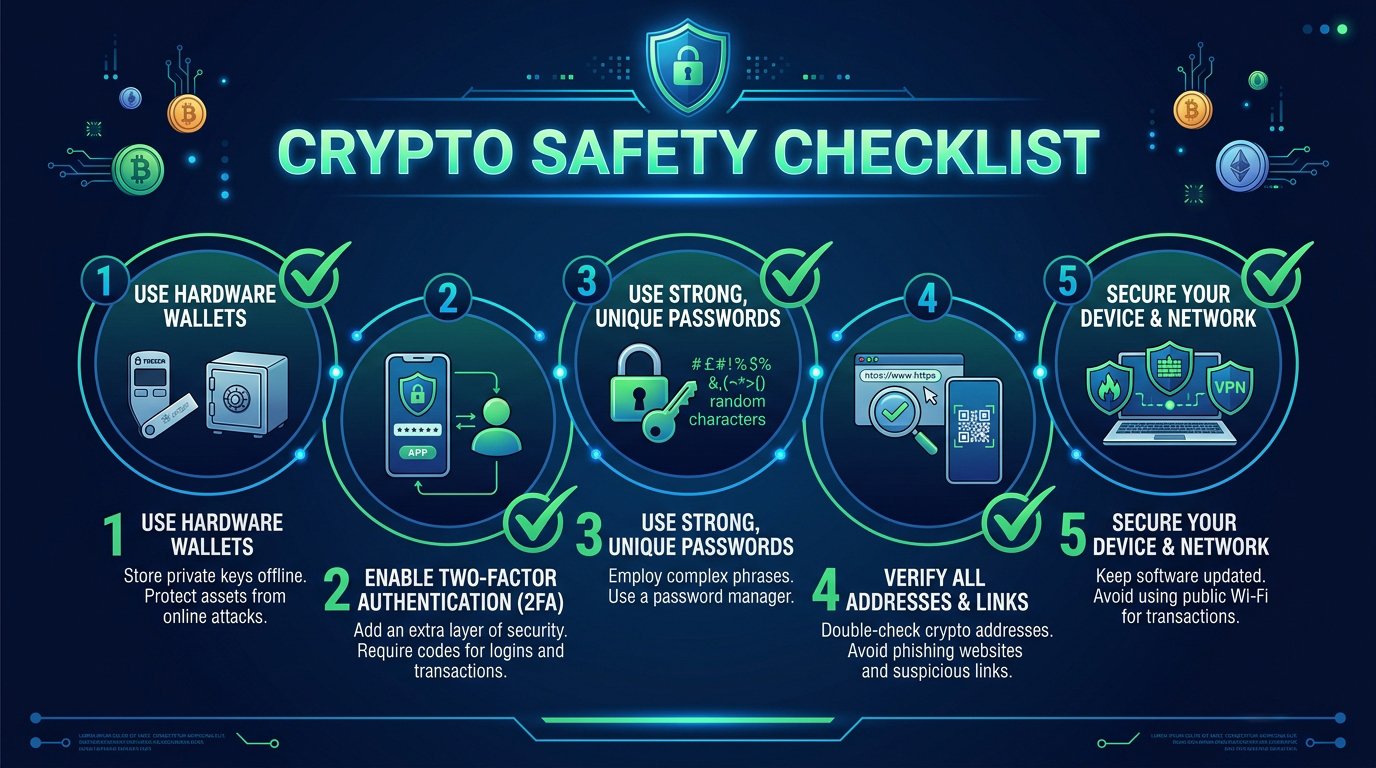
Use Non-Custodial Wallets: Store your cryptocurrency in wallets where you control the private keys. Crypto wallets (like Tangem) provide the best security for long-term holdings.
Enable Two-Factor Authentication: Use 2FA on all exchange and platform accounts. Authenticator apps are more secure than SMS.
Never Share Private Keys: No legitimate platform or person will ever ask for your private keys or seed phrase. Anyone who asks is trying to steal your funds.
Use Unique Passwords: Don’t reuse passwords across platforms. Use a password manager to generate and store strong, unique passwords.
Verify URLs: Phishing sites mimic legitimate platforms. Always verify you’re on the correct website before entering credentials.
Start Small: Don’t invest more than you can afford to lose, especially when starting out. Learn the technology and the risks before committing significant capital.
Diversify: Don’t put all your funds in one cryptocurrency, one platform, or one strategy. Diversification reduces risk.
Keep Software Updated: Wallet software, operating systems, and security software should always be up to date.
Is AI Crypto Trading Trustworthy?
AI cryptocurrency trading has become popular, but it introduces additional considerations:
The Technology is Real: Machine learning algorithms can analyze market data and execute trades faster and more consistently than humans. This isn’t hype, it’s functional technology.
Results Vary Widely: Some AI trading platforms deliver consistent returns, others lose money. The difference is in the quality of the algorithms, the risk management, and the transparency of operations.
Transparency Matters: Trustworthy AI trading platforms provide verifiable performance data, explain how their algorithms work, and don’t promise guaranteed returns.
Non-Custodial is Safer: AI trading platforms that use non-custodial architecture (where your funds stay in your own wallet) are safer than those that require you to deposit funds.
Due Diligence is Essential: Before using any AI trading platform, research its track record, verify its claims, understand its fee structure, and start with a small allocation.
Platforms like Aurum exemplify trustworthy AI trading: non-custodial architecture, transparent performance data (Neyro at ~31% monthly, EX at ~18% monthly), institutional expertise, and a focus on security. They’ve operated since early 2026 with consistent results.
Learn more about Aurum’s trustworthy AI trading →
What Are the Signs of a Crypto Scam?
Protect yourself by recognizing common scam patterns:
Guaranteed Returns: No legitimate investment guarantees returns. If someone promises you’ll make X% with no risk, it’s a scam.
Pressure to Act Quickly: Legitimate investments don’t require immediate decisions. Scammers create urgency to prevent you from thinking critically.
Unrealistic Promises: “Turn $100 into $10,000 in a week” is a scam. Cryptocurrency can be profitable, but not that fast or that consistently.
Anonymous Teams: Legitimate projects have identifiable teams with verifiable backgrounds. Anonymous teams are red flags.
Complex Strategies You Don’t Understand: If you can’t explain how the investment makes money, don’t invest. Complexity is often used to hide scams.
Requests for Private Keys: No legitimate platform asks for your private keys. This is always a scam.
Unregistered Offerings: Legitimate securities are registered with regulatory bodies. Unregistered offerings may be illegal.
Should You Invest in Cryptocurrency?
The decision to invest in cryptocurrency depends on your personal circumstances:
You might consider crypto if:
- You have emergency savings and stable income
- You can afford to lose your investment
- You understand the technology and risks
- You have a long-term time horizon (5+ years)
- You’re willing to learn proper security practices
- You’re diversifying a portfolio that includes traditional assets
You might avoid crypto if:
- You need the money soon
- You can’t afford to lose any of it
- You don’t have time to learn proper security
- You’re investing based on tips from friends or social media
- You’re putting all your savings into crypto
Cryptocurrency is a legitimate asset class with real opportunities and real risks. The question isn’t whether to trust crypto categorically, it’s whether you can navigate the space safely and make informed decisions.
How to Get Started Safely
If you decide to invest in cryptocurrency, here’s a safe path forward:
- Educate yourself about blockchain technology, wallets, and security
- Start with small amounts you can afford to lose
- Use reputable platforms with proven track records
- Secure your assets with hardware wallets and proper security practices
- Diversify across multiple cryptocurrencies and platforms
- Stay informed about regulatory changes and security threats
- Never stop learning the space evolves rapidly
Final Thoughts
Trust in cryptocurrency isn’t binary, it’s contextual. The technology itself is trustworthy in the sense that it’s mathematically secure and transparent. Individual projects vary widely in legitimacy. Platforms range from highly secure to outright fraudulent. Your personal security practices determine much of your actual risk.
The cryptocurrency industry has matured significantly since 2009. Today’s platforms offer institutional-grade security, regulatory compliance, and transparent operations. But the space still requires caution, education, and careful decision-making.
If you approach cryptocurrency with realistic expectations, proper security practices, and a commitment to ongoing education, you can participate in this innovative asset class while managing the risks. The key is treating crypto as what it is: a legitimate but volatile and technically complex asset class that rewards informed participants.
Ready to explore cryptocurrency trading with proper security? Learn more about Aurum’s non-custodial AI trading platform.
This post is for informational purposes only and is not financial advice. Cryptocurrency investment involves substantial risk of loss. Always do your own research and never invest more than you can afford to lose.
